Saturday, February 27, 2021

The Strangest Secret by Earl Nightingale

The Strangest Secret

The Strangest Secret: Nightingale, Earl: 9781603865579: Amazon.com: Books

SUCCESS: Success is the progressive realization of a worthy ideal.”

GOALS: People with goals succeed because they know where they’re going

WE BECOME WHAT WE THINK ABOUT

AS YE SOW and SO SHALL YE REAP

30-DAY ACTION


Internet Archive Search: creator:"Earl Nightingale"

"THE STRANGEST SECRET IN THE WORLD " EARL NIGHTINGALE MOTIVATIONAL FILM SECRETS OF SUCCESS 50764 : PeriscopeFilm : Free Download, Borrow, and Streaming : Internet Archive


PNTV: The Strangest Secret by Earl Nightingale (#174) - YouTube

How to Master the Basic Fundamentals of Life and Success - Earl Nightingale - YouTube

Earl Nightingale in this lectures shares the two most important lessons for success. The first rule includes knowing what you want in life so that you can devote most of your time towards attaining that and believing that you can achieve that goal. Next rule is that of interdependency, you can win or loose in life based on your service to others.

The Strangest Secret by Earl Nightingale @GoodReads

The Strangest Secret - Wikipedia

The Strangest Secret was a 1956 spoken word record by Earl Nightingale which sold over one million copies and received the first Gold Record for the spoken word,[1] which helped launch the fields of business motivation and audio publishing. It was later adapted into print and video forms.[2][3]


summaries / reviews


Inspirational quotes 

“Success is the progressive realization of a worthy ideal.” — Earl Nightingale

“The opposite of courage in our society is not cowardice; it is conformity.” — Rollo May

“The only person who succeeds is the person who’s progressively realizing a worthy ideal.” — Earl Nightingale

“A success is anyone who is doing deliberately a predetermined job because that’s what he decided to do deliberately.” — Earl Nightingale

“Instead of competing, all we have to do is create.” — Earl Nightingale

“Selling is the highest paid profession if we’re good at it and know where we’re going.” — Earl Nightingale

“A man’s life is what his thoughts make of it.” — Marcus Aurelius

“Everything comes if a man will only wait. I brought myself by long meditation to the conviction that a human being with a settled purpose must accomplish it and that nothing can resist a will that stay even existent for its fulfillment.” — Benjamin Disraeli

“A man is what he thinks about all day long.” — Ralph Waldo Emerson

“The greatest discovery of my generation is that human beings can alter their lives by altering their attitudes of mind.” — William James

“If you only care enough for a result, you will almost certainly attain it. If you wish to be rich, you will be rich. If you wish to be learned, you will be learned. If you wish to be good, you’ll be good. Only you must really wish these things and wish them exclusively and not wish at the same time a hundred other incompatible things just as strongly.” —William James

“If thou canst believe, all things are possible to him that believeth.” — Mark 9:23

“This is one of the greatest laws in the universe. Fervently do I wish I had discovered it as a very young man. It dawned upon me much later in life and I found it to be the greatest, if not my greatest discovery outside of my relationship to God. Simply stated if you think in negative terms, you’ll get negative results. If you think in positive terms, you achieve positive results…This is the basis of the prosperity of success. In three words: Believe and Succeed.” — Norman Vincent Peale

“People are always blaming their circumstances for what they are. I don’t believe in circumstances. The people who get on in this world are the people who get out and look for the circumstances they want and, if they can’t find them, make them.” — George Bernard Shaw

“Everyone is the sum total of his own thoughts.” — Earl Nightingale

“What you think today and tomorrow will mold your life and determine your future.” — Earl Nightingale

Sermon on the Mount: “Ask, and it shall be given you. Seek, and you shall find. Knock, and it shall be opened onto you.”

"Ask, and it will be given to you; seek, and you will find; knock, and it will be opened to you."
Matthew 7:7 Meaning of Ask and It Will Be given to You – ConnectUS


code: (ask, seek, knock) => (get, find, open)

“Success isn’t the result of making money; making money is the result of success.
Success is in direct proportion to our service.” — Earl Nightingale


Saturday, January 23, 2021

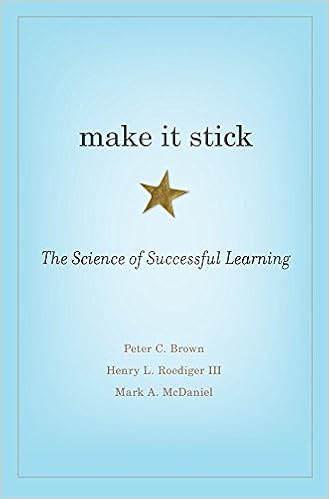
book: Make It Stick: The Science of Successful Learning

 Make It Stick: The Science of Successful Learning: Brown, Peter C., Roediger III, Henry L., McDaniel, Mark A.: 4708364242277: Amazon.com: Books

TOC:

  1. Learning is misunderstood
  2. To learn, retrieve
  3. Mix up your practice
  4. Embrace difficulties
  5. Avoid illusions of knowing
  6. Get beyond learning styles
  7. Increase your abilities
  8. Make it stick.

Make It Stick: The Science of Successful Learning | Barbara Oakley

" one of the very best books on learning currently in existence
...
it’s a wonderful romp through the various techniques that are valuable in making your learning stick. What has impressed us is not only the scientific rigor of the work (thanks, Henry Roediger III and Mark McDaniel!), but also Peter’s in-depth explanations and wide-ranging examples—this is not a fluff job of a book"


  • Mindless repetition does not build memory – quality, type and timing of repetition are each as important as quantity;
  • Fluency is not the same as understanding – just because you can repeat something, it doesn’t mean you get it;
  • Creativity and knowledge are not separate – creativity requires knowledge, and knowledge must be memorized.

  • Self-quizzes 
  • Interleaving, randomize
  • Spaced repetition (next day, week, month)
Effort = Retention

interview with the book author:

"The first one is that we think of learning as getting stuff into the brain,
but it turns out that learning really happens

when we struggle to get stuff out of the brain.
It's that effort to recall, explain, relate, put in our own words,
something new or a new skill or semantic knowledge, that really leads to the learning.
Moving the new material from short-term memory into long-term memory
and connecting it to what we already know.
So, getting it out, not trying to put it in, is key.
And most of us, when we're trying to get something,
we'll just re-read and re-read and try to re-expose ourselves to it.
To burn it in.That doesn't work.

The second big idea for me is
that there are some kinds of difficulties
that are, in fact, desirable for long-term learning
.
I’ve made the point that trying to get learning out of the mind is an important strategy.
It turns out that if you space out your practice,
so that you've gotten a little rusty on the new material,
it takes extra effort to retrieve it.
That added difficulty causes the mind to reconsolidate the learning.
And it strengthens the connections to what you already know.
And the cues to retrieve it again later.
There are other difficulties like mixing up the practice of similar problem types.
Instead of focusing on one type, you know -
... 
So, mixed practice is, uh, interleaving the practice of similar problem types,
is a very powerful difficulty that is desirable.
And there are some others as well.
So, there are certainly difficulties that are not desirable.
If you read something in a language you don't know, that's an undesirable difficulty.
I mean, we can think of many undesirable difficulties.
But not all difficulty is undesirable.

The third big idea for me is this notion
that when we learn something new, we are actually,
uh, it's not like getting a new bump on the head.
But we are re-wiring our brains.
Our neurons are growing a new axon to connect with other neurons.
This came home to me, visually, in a video in a clip,
a Nova TV clip of a neural scientist, Eric Kandel,
who has won a Nobel for his work.
Where you can actually see a video of a sea slug neuron
being stimulated and the axon growing out to reach another neuron.
It is a physical phenomenon.
The point being that through the right kind of mental engagement,
that kind of effort, we are changing our minds
and increasing our mental abilities.
Our mental abilities are not fixed with the gift of our genes.
We have the ability to substantially affect our mental abilities
through the right kinds of learning effort.
It re-wires the brain.
It feels difficult, there's actually a reason.
You're re-wiring your brain.
So, the third big idea for me is this idea of a growth mindset.

The fourth one from the research that what feels productive, often is not.
Our intuition often leads us astray...
What you don't understand is that improvement resides in short-term memory.
And it hasn't been consolidated in long-term memory.
It takes hours or days for learning
to be migrated from short-term memory to long-term memory.
And you walk off the golf course
or leave your classroom with that practice feeling you've got it nailed.
Or you spend all-night in an all-nighter and you do well the next day on the exam,
you think, “I’ve locked that stuff in.”
If you come back a week later, you haven't.
You're astonished to discover it's leaked away in the meantime.
So, you cannot trust your sense of what feels productive
as a gauge of whether you're truly learning.
The gauge you need is to demonstrate through retrieval practice.
Through doing it again later
whether, in fact, you've achieved that or not."

Saturday, January 16, 2021

Peak: How to Master Almost Anything: Ericsson, K. Anders: 9780670068760: Amazon.com: Books

Peak: Secrets from the New Science of Expertise - Wikipedia


021 Arete: book: Peak by Anders Ericsson


How to Master Anything: PEAK by Anders Ericsson | Core Message - YouTube
by ProductivityGame


summary:


Peak: Secrets from the New Science of Expertise by Anders Ericsson


Peak by Anders Ericsson and Robert Pool: Summary, Notes and Lessons - Nat Eliason

"If you only read one book on mastering your craft, read this one.

The central message: The right sort of practice ("deliberate practice") carried out over a sufficient period of time leads to improvement.

A common learning obstacle: If you reach a skill level that feels “satisfactory” to you, you stop improving, and even get worse with time.

Two types of practice:

  • Naive practice in a nutshell: I just played it. I just swung the bat and tried to hit the ball. I just listened to the numbers and tried to remember them. I just read the math problems and tried to solve them. This is how most people “practice” but it’s ineffective.
  • Purposeful practice has well-defined, specific goals. Without such a goal, there is no way to judge whether the practice session has been a success.

Components of purposeful practice:

  • Putting a bunch of baby steps together to hit a long term goal, having a plan
  • Feedback, you have to know whether you are doing something right and if not, what mistakes you’re making
  • Getting outside of your comfort zone, feeling uncomfortable. If you never push beyond your comfort zone you’ll never improve.
  • A way to monitor your progress
  • Maintaining motivation

Other rules of purposeful practice:

  • You won’t improve much without giving the task your full attention 
  • Without feedback— either from yourself or from outside observers— you cannot figure out what you need to improve on or how close you are to achieving your goals.

Mental Representations: Your skill in anything is based on the number and quality of “mental representations” you have for the skill.


Deliberate practice is even better than purposeful practice: 

  1. The field must be well developed, the best performers must be clearly far superior to people just entering the field. 
  2. requires a teacher who can provide practice activities designed to help a student improve his or her performance.
  3. Near maximal effort, constantly being taken out of your comfort zone by a teacher or coach. Not “fun”
  4. Well defined, specific goals, not aimed at “overall improvement.”
  5. Full attention and conscious action, no autopilot.
  6. Feedback and constant little improvements, modifying efforts in response to feedback
  7. Building and modifying mental representations
  8. Focusing on building and improving specific skills by focusing on aspects of those skills and improving them

Saturday, January 9, 2021

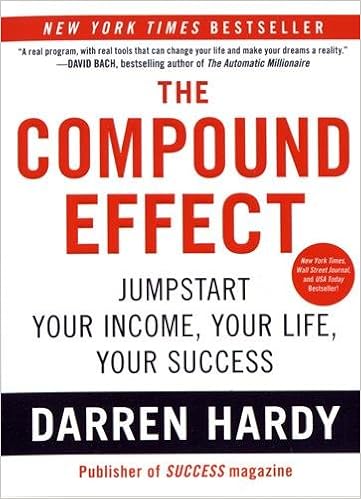
book: The Compound Effect by Darren Hardy

Amazon.com: The Compound Effect (9781593157241): Hardy, Darren: Books

“The first step toward change is awareness. If you want to get from where you are to where you want to be, you have to start by becoming aware of the choices that lead you away from your desired destination. Become very conscious of every choice you make today so you can begin to make smarter choices moving forward.” – Darren Hardy


Daily Consistency = Massive Results: THE COMPOUND EFFECT by Darren Hardy | Core Message - YouTube

Resist the urge to see immediate results and receive short-term payoffs. Instead, construct a daily habit of constant improvements to generate the compound effect in your life and produce incredible results.

PNTV: The Compound Effect by Darren Hardy (#128) - YouTube


Darren Hardy - Wikipedia


The Compound Effect (book web side, "free" book)

The Compound Effect Resources Resource Access


Official Site of Darren Hardy | Success Mentor and New York Times Best Seller

5 Must-Have Traits to #BeTheException

  1. Your Adversities Are Your Advantage
  2. Have PURPOSE and Live In Alignment With It
  3. Use failure as FUEL
  4. Ignite Strong FEELINGS
  5. Strive and Push for MORE


Book Summary: The Compound Effect by Darren Hardy (by James Clear)

The compound effect is the strategy of reaping huge rewards from small, seemingly insignificant actions. You cannot improve something until you measure it. Always take 100 percent responsibility for everything that happens to you.


  • only a few things matter: find them, stick to them, master them


Darren Daily podcast feed


another book from the same author