Wednesday, June 28, 2017

Positive Psychology

2016: Positive Psychology with Martin Seligman - YouTube

TED 2004: The new era of positive psychology | Martin Seligman - YouTube

Martin Seligman - Wikipedia

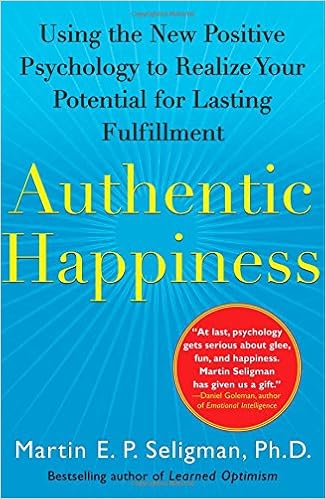
Authentic Happiness | Authentic Happiness

Foundations of Positive Psychology | Coursera
$79 USD per month, includes certificate, or "audit" (watch only) for free
University of Pennsylvania
  • Positive Psychology: Martin E.P. Seligman’s Visionary Science with Dr. Martin E.P. Seligman
    • Jun 26 — Jul 31
  • Positive Psychology: Applications and Interventions with Dr. James Pawelski
  • Positive Psychology: Character, Grit and Research Methods with Dr. Angela Duckworth & Dr. Claire Robertson-Kraft
    • Jun 26 — Jul 31
  • Positive Psychology: Resilience Skills with Dr. Karen Reivich
  • Positive Psychology Specialization Project with Dr. Martin E.P. Seligman


Psychology:
  1. reduce misery
  2. increase happiness 
Three "Happy" Lives:
  • "Pleasant" life (heritable, hard to change, easy to get used to)
  • "Good" life (Engagement, Flow, time stops)
  • "Meaningful" life 

Authentic Happiness: Using the New Positive Psychology to Realize Your Potential for Lasting Fulfillment: Martin E. P. Seligman: 8601404545245: Amazon.com: Books

Authentic Happiness by Martin Seligman - YouTube
review by Brian Johnson

“…there is astonishing convergence across the millennia and across cultures about virtue and strength. Confucius, Aristotle, Aquinas, the Bushido samurai code, the Bhagavad-Gita, and other venerable traditions disagree on the details, but all of these codes include six core virtues:  
  • Wisdom and knowledge
  • Courage
  • Love and humanity
  • Justice
  • Temperance
  • Spirituality and transcendence
“I do not believe that you should devote overly much effort to correcting your weaknesses.
Rather, I believe that the highest success in living and the deepest emotional satisfaction comes from building and using your signature strengths.”


Job => Career => Calling
"Know your strengths, use them often, you will be happier"


Learned Optimism: How to Change Your Mind and Your Life - Kindle edition by Martin E.P. Seligman. Religion & Spirituality Kindle eBooks @ Amazon.com.

Learned Optimism by Martin Seligman - YouTube
review by Brian Johnson

“Habits of thinking need not be forever. One of the most signi
in psychology in the last twenty years is that individuals can change how
they think.”
-
 Martin Seligman

“Learned optimism is not a rediscovery of the ‘power of positive thinking.’ … Changing the
destructive things you say to yourself when you experience the setbacks that life deals all of us is
the central skill of optimism.”


“There are three crucial dimensions to your explanatory style:

  • Permanence: Is it likely to continue? Is it permanent or temporary?  
    • Good: pessimist things is temporary, optimists things is permanent
    • Bad:  pessimist things is permanent, optimists things is temporary
  • Pervasiveness: Is it reflective of your whole life? Is it “universal” or is it “specific”?  
    • Good: pessimist: fluke, optimists: universal
    • Bad:  pessimist: universal, optimists: fluke
  • Personalization: Internal or external?  
    • Good: pessimist: external, optimists: internal
    • Bad: pessimist: internal, optimists: external
Start paying attention to your internal dialogue, notice the patterns, and try to optimize your three P’s... when anxious or worried, pause for a moment and pay attention to what you’re saying to yourself

“Unlike dieting, learned optimism is easy to maintain once you start. Once you get into the
habit of disputing negative beliefs, your daily life will run much better, and you will feel much
happier.”


Characteristics for job success:
  1. Aptitude
  2. Motivation
  3. Optimism  
"Success requires persistence, the ability to not give up in the face of failure. I believe that
optimistic explanatory style is the key to persistence.”
  
- Martin Seligman

What is Active and Constructive Responding? | GoStrengths!


Active & Constructive Responding - YouTube
by Dr. Martin Seligman
Active Constructive Responding - YouTube


Building Resilience by Martin E.P. Seligman @ HBR, 2011


Building the State of Wellbeing
 - A Strategy for South Australia
 - Professor Martin Seligman (PDF)


Tuesday, June 20, 2017

book: The paradox of choice

Paradox of Choice cover.jpg
Barry Schwartz: The paradox of choice | TED Talk | TED.com

The paradox of choice | Barry Schwartz - YouTube

The Paradox of Choice - Wikipedia

"The Paradox of Choice - Why More Is Less is a 2004 book by American psychologist Barry Schwartz. In the book, Schwartz argues that eliminating consumer choices can greatly reduce anxiety for shoppers.

Autonomy and Freedom of choice are critical to our well being, and choice is critical to freedom and autonomy. Nonetheless, though modern Americans have more choice than any group of people ever has before, and thus, presumably, more freedom and autonomy, we don't seem to be benefiting from it psychologically."

The Paradox of Choice: Why More Is Less: Barry Schwartz, Ken Kliban: 9781491514238: Amazon.com: Books


New Great Design Science with Mark Miller @ .NET Rocks! vNext

book: The 5 Second Rule

podcast interview with author:
#208: Mel Robbins—5 Seconds to a Better Life and Business | EntreLeadership

How to stop screwing yourself over | Mel Robbins | TEDxSF - YouTube

The Five Elements of the The 5 Second Rule
"The 5 Second Rule is simple. If you have an instinct to act on a goal, you must physically move within 5 seconds or your brain will kill it."
book site: Mel Robbins | The 5 Second Rule Author
Chapter 1

The 5 Second Rule | Mel Robbins | Book Summary, Reviews

The 5 Second Rule: Transform your Life, Work, and Confidence with Everyday Courage: Mel Robbins: 9781682612385: Amazon.com: Books

Friday, May 26, 2017

Elon Musk's First Principles


Elon Musk's First Principles - Business Insider

"Before he was a world-changing entrepreneur, Elon Musk was on track to become a physicist - even starting an applied physics Ph.D. at Stanford University
... it trained him in "first principles thinking," a mode of inquiry that relentlessly pursues the foundations of a problem.

"I think it's important to reason from first principles rather than by analogy," Musk said in an interview with Kevin Rose.

"The normal way we conduct our lives is we reason by analogy," he said. "[With analogy] we are doing this because it's like something else that was done, or it is like what other people are doing. [With first principles] you boil things down to the most fundamental truths … and then reason up from there."


"How is it even possible that Elon Musk could build four multibillion companies by his mid-40s — in four separate fields (software, energy, transportation, and aerospace)?
....
this article... calls people like Musk “expert-generalists” ... study widely in many different fields, understand deeper principles that connect those fields, and then apply the principles to their core specialty.
...
Starting from his early teenage years, Musk would read through two books per day in various disciplines according to his brother,"
....

First, he deconstructs knowledge into fundamental principles
Musk’s answer on a Reddit AMA describes how he does that:

"It is important to view knowledge as sort of a semantic tree — make sure you understand the fundamental principles, i.e. the trunk and big branches, before you get into the leaves/details or there is nothing for them to hang onto."
...
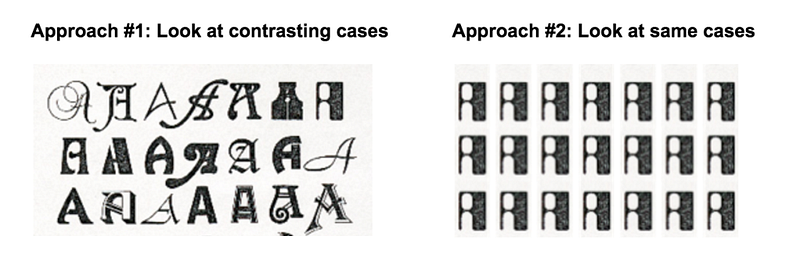
By looking at lots of diverse cases when we learn anything, we begin to intuit what is essential and even craft our own unique combinations.
What does this mean in our day-to-day life? When we’re jumping into a new field, we shouldn’t just take one approach or best practice. We should explore lots of different approaches, deconstruct each one, and then compare and contrast them. This will help us uncover underlying principles."

Foundation 20 // Elon Musk - YouTube
interview by Kevin Rose

Elon Musk Interview 2017 | TEDTalk - YouTube

Richard Feynman - Wikiquote
The first principle is that you must not fool yourself 
and you are the easiest person to fool.The first principle is that you must not fool yourself and you are the easiest person to fool. - Richard P. Feynman

Monday, May 22, 2017

learning: Spaced repetition, Active recall

Spaced repetition - Wikipedia


"Spaced repetition is a learning technique that incorporates increasing intervals of time between subsequent review of previously learned material in order to exploit the psychological spacing effect."

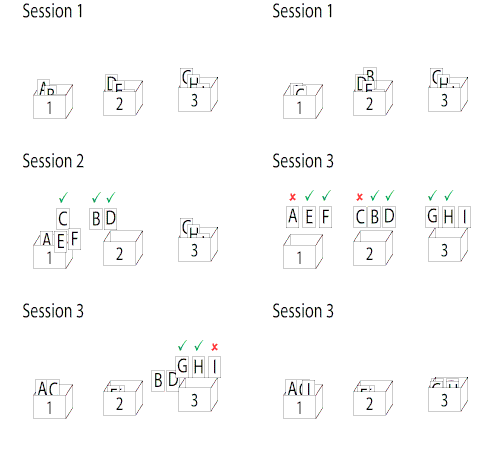
"In the Leitner system, correctly answered cards are advanced to the next, less frequent box, while incorrectly answered cards return to the first box for more aggressive review and repetition."

computer-assisted language learning software-based solutions

Active recall - Wikipedia

"Active recall is a principle of efficient learning, which claims the need to actively stimulate memory during the learning process. It contrasts with passive review, in which the learning material is processed passively (e.g. by reading, watching, etc.)."


Sunday, May 21, 2017

Ideal Work, Hedgehog Concept, Excellence

Ideal work: Good at + Paid well + Love to do

The order is important!
  • it helps to have some predisposition, but need to put effort, learn to get good at, 
  • find place that pays to do challenging work and learn to get better
  • and the more you learn, the more you love doing what you are doing great (excellent)
Blue Badge - Scott Hanselman


Your images are a virus. They are EVERYWHERE on the Internet - Scott Hanselman

Jim Collins - Concepts

Amazon.com: Good to Great: Why Some Companies Make the Leap and Others Don't (8601300383743): Jim Collins: Books


Good to Great - Wikipedia
  • "Level 5 Leadership: Leaders who are humble, but driven to do what's best for the company.
  • First Who, Then What: Get the right people on the bus, then figure out where to go. Finding the right people and trying them out in different positions.
  • Confront the Brutal Facts: The Stockdale paradox—Confront the brutal truth of the situation, yet at the same time, never give up hope.
  • Hedgehog Concept: Three overlapping circles: 
    • What lights your fire ("passion")? 
    • What could you be best in the world at ("best at")? 
    • What makes you money ("driving resource")?
  • Culture of Discipline: Rinsing the cottage cheese.
  • Technology Accelerators: Using technology to accelerate growth, within the three circles of the hedgehog concept.
  • The Flywheel: The additive effect of many small initiatives; they act on each other like compound interest."
The Hedgehog Concept


"What is the Hedgehog Concept? It’s a similar axiom to the One Thing. Based on the famous essay by Isaiah Berlin, “The Hedgehog and the Fox” describes how the world is divided into two types. 

  • The fox knows many things. The fox is a very cunning creature, able to devise a myriad of complex strategies to sneak attack upon hedgehog. 
  • The hedgehog knows one big thing, rolling up into a perfect little ball thus becoming a sphere of sharp spikes, pointing outward in all directions. 
The hedgehog always wins despite the different tactics the fox uses."


Deep Work: Rules for Focused Success in a Distracted World: Cal Newport: 9781455586691: Amazon.com: Books


Deep Work: Rules for Focused Success in a Distracted World - Cal Newport

"Deep work is the ability to focus without distraction on a cognitively demanding task. It’s a skill that allows you to quickly master complicated information and produce better results in less time. Deep work will make you better at what you do and provide the sense of true fulfillment that comes from craftsmanship. In short, deep work is like a super power in our increasingly competitive twenty-first century economy. And yet, most people have lost the ability to go deep—spending their days instead in a frantic blur of e-mail and social media, not even realizing there’s a better way."


"In this eye-opening account, Cal Newport debunks the long-held belief that “follow your passion” is good advice. Not only is the cliche flawed—preexisting passions are rare and have little to do with how most people end up loving their work—but it can also be dangerous, leading to anxiety and chronic job hopping.

...
Matching your job to a preexisting passion does not matter, he reveals. Passion comes after you put in the hard work to become excellent at something valuable, not before. In other words, what you do for a living is much less important than how you do it."


"Durant sums up some of Aristotle’s thoughts... from Aristotle’s Nicomachean Ethics (“these virtues are formed in man by his doing the actions”), Durant sums it up this way:
…we are what we repeatedly do. Excellence, then is not an act but a habit.” "


These virtues are formed in man by his doing the actions ... The good of man is a working of the soul in the way of excellence in a complete life. - Aristotle

"Arete (Greek: ἀρετή), in its basic sense, means "excellence of any kind".
The term may also mean "moral virtue"
this notion of excellence was ultimately bound up with the notion of the
fulfillment of purpose or function: the act of living up to one's full potential."


Amazon.com: Chess Not Checkers: Elevate Your Leadership Game (9781626563940): Mark Miller: Books
"The early days of an organization are like checkers: a quickly played game with mostly interchangeable pieces. Everybody, the leader included, does a little bit of everything; the pace is frenetic. But as the organization expands, you can't just keep jumping from activity to activity. You have to think strategically, plan ahead, and leverage every employee's specific talents—that's chess. Leaders who continue to play checkers when the name of the game is chess lose."